

Views: 0 Author: Site Editor Publish Time: 2025-10-28 Origin: Site
In the modern mineral processing industry, gravity separation plays a vital role in recovering valuable minerals from ores of varying densities. As environmental awareness and efficiency standards rise, selecting advanced gravity separation equipment has become a key focus for mining enterprises worldwide. Among these solutions, the ABS spiral chute has emerged as a next-generation design that combines superior material technology, structural innovation, and high recovery performance.
This article explores how the ABS spiral chute enhances gravity separation efficiency—from its optimized design and material composition to its practical applications in modern mineral processing plants.
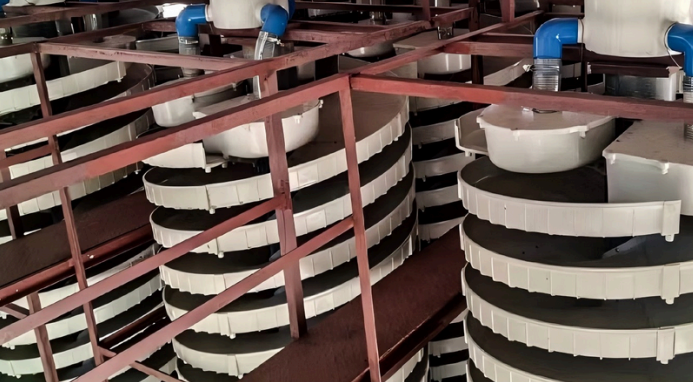
Gravity separation is one of the oldest and most widely used ore beneficiation methods. It relies on the differences in specific gravity between minerals and uses flowing water and gravity to separate heavier particles from lighter gangue materials.
The spiral chute functions as a vertically arranged, helical channel that guides the slurry downward. As the slurry flows, particles experience a combination of gravity, centrifugal force, and fluid drag. Denser minerals migrate toward one side of the chute, while lighter ones move toward the opposite side.
In a conventional spiral separator, several factors—such as pitch angle, water flow, and surface smoothness—directly affect recovery rates and separation precision. The ABS spiral chute addresses these through material optimization and modular structural improvements.
In harsh mineral environments, traditional fiberglass-reinforced plastic (FRP) spiral chutes often face corrosion, deformation, and abrasion. Over time, these issues reduce separation efficiency and increase maintenance costs.
To overcome these limitations, engineers introduced ABS plastic (Acrylonitrile Butadiene Styrene) as the primary material. ABS features high impact resistance, excellent wear resistance, and chemical stability, making it ideal for handling wet and corrosive slurries.
Durability: ABS has a 40% longer lifespan than standard steel or FRP chutes.
Corrosion Resistance: It maintains performance in acidic or alkaline environments (pH 3–11).
Lightweight Design: ABS reduces total equipment weight by up to 60%, easing installation and transport.
Energy Efficiency: The smoother inner surface minimizes frictional loss, allowing better slurry flow and reducing water consumption.
By replacing heavy and corrosion-prone materials with high-performance polymers, the ABS spiral chute achieves long-term stability while maintaining high recovery rates even in aggressive operating conditions.
The modern ABS spiral chute typically includes 12-15 vertically stacked spiral truns mounted with 2-4 starts around a central support column.
Each turn has an optimized curve profile, ensuring consistent slurry flow and uniform separation performance.
The modular assembly allows multiple chutes to be combined for large-scale operations or disassembled for convenient shipping.
Efficiency in gravity separation depends heavily on fine-tuning operational parameters. The ABS spiral chute enables flexible adjustment of:
Feed concentration: typically 25–40% solids by weight
Inclination angle: between 9° and 12°, depending on mineral density
Wash water pressure: between 0.05–0.1 MPa for optimal fine particle recovery
These adjustable controls make it possible to adapt the chute to different minerals—such as ilmenite, cassiterite, wolframite, monazite, or zircon—ensuring high recovery across diverse applications.
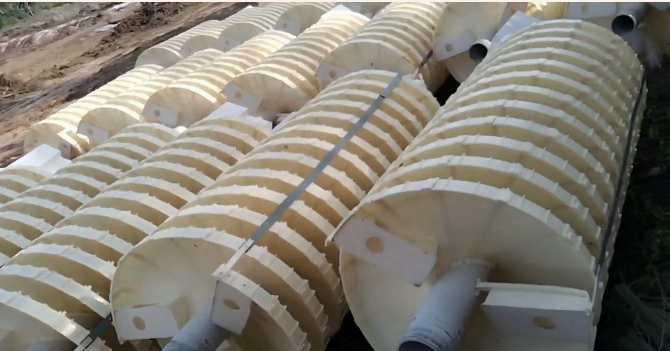
Conventional gravity separation equipment often struggles to recover minerals smaller than 0.1 mm. Fine particles are easily carried away by water flow or fail to stratify efficiently. The ABS spiral chute addresses this with an improved surface curve and optimized flow path, which increase residence time and promote effective stratification of fine particles.
Through laboratory tests and field trials, it has been demonstrated that the ABS spiral chute can process mineral particles within the 0.074–1 mm range, achieving up to 92% ilmenite recovery. By refining wash water control and maintaining consistent feed density, operators can recover even the finest valuable minerals with reduced tailing grades.
In today’s mining industry, sustainability and environmental compliance are critical. The ABS spiral chute operates entirely on gravity, requiring no additional power source. This not only reduces operational energy costs but also minimizes noise and carbon emissions.
Furthermore, the system uses up to 50% less water than conventional designs, reducing the environmental footprint while maintaining excellent separation efficiency. Combined with its corrosion-resistant, long-life structure, the ABS chute offers a sustainable alternative for green mineral processing operations.
The ABS spiral chute is highly versatile and applicable to both ferrous and non-ferrous minerals, including:
gold,coal,chromite, coal
Iron ore (hematite, magnetite)
Titanium ore (ilmenite, rutile)
Tungsten ore (wolframite)
Tin ore (cassiterite)
Tantalum-niobium ore
Zircon and monazite
Quartz and feldspar for impurity removal
It can be applied in roughing, scavenging, and cleaning stages or used for secondary recovery in tailings treatment.
The modular design allows field assembly without specialized machinery. Workers can learn installation procedures within two hours, significantly shortening commissioning time. Because the chute has no moving parts, maintenance costs are minimal, and operational reliability remains high.
When compared with traditional FRP or steel spiral chutes, the ABS model delivers clear advantages:
| Feature | Traditional FRP Chute | ABS Spiral Chute |
|---|---|---|
| Material | Fiberglass | ABS + Polyurethane / PC Alloy |
| Corrosion Resistance | Moderate | Excellent |
| Weight | Heavy | 60% Lighter |
| Fine Particle Recovery | Average | High |
| Service Life | 12–18 months | 24+ months |
| Energy Requirement | None | None (Gravity-driven) |
| Maintenance | Regular cleaning | Minimal |
These improvements make the ABS spiral chute an ideal upgrade for modern beneficiation plants aiming to increase productivity and reduce operational downtime.
Mining companies worldwide have successfully adopted ABS spiral chutes to enhance efficiency.
South Africa – Ilmenite Plant: Achieved 90% recovery with 40% reduction in water use.
Indonesia – Tin Mine: Increased fine cassiterite recovery from 70% to 88%.
Nigeria – Tantalum-Niobium Ore: Modular installation reduced setup time by 65%.
These examples show the chute’s adaptability to different mineral types and working environments, confirming its reliability and versatility in diverse mining projects.
As digitalization and automation advance in the mining industry, future ABS spiral chutes may incorporate smart monitoring systems for real-time performance tracking. Integration with IoT-based sensors could provide instant feedback on slurry density, flow rate, and product quality—helping operators fine-tune parameters and maintain peak efficiency.
Continued research into composite polymer materials will likely extend the lifespan further and enable even higher recovery of ultrafine particles.
Jiangxi Fangcheng Mining Equipment Manufacturing Co., Ltd. is a professional manufacturer specializing in mineral processing equipment design, production, and installation. With nearly two decades of experience in gravity separation technology, Fangcheng provides customized solutions covering ore feeding, crushing, screening, magnetic separation, flotation, and drying systems.
The company’s ABS spiral chute series represents its commitment to innovation, energy efficiency, and sustainable mineral processing. With advanced R&D facilities, strict quality inspection, and a global customer base across more than 20 countries, Fangcheng continues to lead in delivering intelligent and dependable mineral separation equipment to the international market.
Q1: What is the ideal particle size range for the ABS spiral chute?
The chute is best suited for particles between 0.074–1 mm, ensuring efficient stratification and recovery of fine minerals.
Q2: How does the ABS material improve corrosion resistance?
ABS plastic is chemically stable and resistant to acids and alkalis, allowing it to operate in slurry environments with pH levels between 3 and 11 without degradation.
Q3: Can the ABS spiral chute handle multiple mineral types?
Yes. It efficiently separates various ferrous and non-ferrous minerals, including iron, titanium, tin, tungsten, tantalum, niobium, and zircon.
Q4: What maintenance does the chute require?
Because it has no moving parts, the chute requires only periodic inspection and cleaning, significantly lowering operating costs.
Q5: Is the ABS spiral chute environmentally friendly?
Absolutely. It uses no power source other than gravity and reduces water consumption by up to 50%, aligning with eco-friendly mining standards.


