

Views: 0 Author: Site Editor Publish Time: 2025-11-05 Origin: Site
In the constantly evolving field of mineral processing, separation technology continues to play a crucial role in determining the efficiency and profitability of mining operations. Among the many types of gravity separation equipment, the ABS spiral chute has gained significant attention for its efficiency, durability, and adaptability to a wide range of mineral types. But what exactly is an ABS spiral chute, and why has it become a preferred choice in modern mineral beneficiation?

An ABS spiral chute is a gravity separation device that uses spiral motion and differential particle density to separate valuable minerals from gangue. It is primarily constructed using ABS (Acrylonitrile Butadiene Styrene)—a high-strength polymer known for its toughness, stability, and resistance to wear and deformation.
The equipment operates without mechanical movement or external power. Instead, it utilizes gravity, centrifugal force, and fluid dynamics to separate minerals as slurry flows through the spiral path. This makes it not only energy-efficient but also environmentally friendly, providing a simple yet highly effective solution for mineral classification and concentration.
For decades, fiberglass-reinforced plastic (FRP) spiral chutes were widely used in mining operations. However, they came with limitations: brittle structure, poor wear resistance, and short lifespan under continuous use. The ABS spiral chute represents a new generation of equipment that overcomes these weaknesses through material and structural innovations.
By combining ABS, polyurethane, polycarbonate alloy, and nylon composites, the latest polymer spiral chutes offer:
Superior abrasion resistance for long-term operation
Flexibility to withstand heavy mineral loads without cracking
Resistance to deformation caused by moisture or temperature changes
Extended lifespan with minimal maintenance
These improvements make the ABS spiral chute especially suitable for intensive use in gravity separation plants, sand mineral projects, and fine mineral recovery systems.
The ABS spiral chute is designed with a precisely engineered spiral curve and cross-sectional profile to ensure efficient mineral stratification. When the slurry mixture enters the top of the chute, the following process occurs:
Feed Distribution – The slurry is evenly fed into the spiral through the feed hopper, spreading along the inner surface.
Particle Stratification – As the slurry flows downward, gravity and centrifugal forces push denser mineral particles inward, while lighter particles are carried outward.
Layer Formation – Multiple distinct layers form within the flowing film, allowing clear separation between heavy and light fractions.
Product Collection – The separated minerals are collected at the bottom via adjustable discharge outlets or recovery buckets, ensuring optimal recovery of valuable concentrates.
This principle allows the ABS spiral chute to handle minerals with a wide range of densities—ideal for iron ore, tungsten, tin, tantalum, niobium, zircon, monazite, rutile, and phosphate rock.
The combination of an optimized spiral structure and smooth polymer surface minimizes turbulence, enabling precise layering of mineral particles. As a result, the chute delivers higher recovery rates and cleaner concentrate grades compared with conventional spiral separators.
ABS and polyurethane materials are highly resistant to abrasion. This ensures that the chute maintains its smooth surface even after prolonged exposure to sharp mineral particles, which greatly reduces replacement frequency and operational downtime.
The equipment is built using a modular assembly system, allowing each spiral section to be disassembled and reassembled on-site. This reduces shipping costs, simplifies installation, and enables operators to perform maintenance without specialized tools.
The ABS spiral chute performs exceptionally well in a variety of environments—from mountain-based processing plants to coastal and river sand mining operations. Its versatility across both metallic and non-metallic ores makes it a universal choice in modern mineral beneficiation.
The success of the ABS spiral chute lies not only in its material innovation but also in its scientific approach to mineral separation. Compared to older designs, it provides:
Higher operational stability due to improved flow control
Reduced water consumption through efficient flow dynamics
Longer service life, reducing total cost of ownership
Improved fine particle recovery, especially for minerals below 0.1 mm
Minimal maintenance requirements, making it suitable for remote mining sites
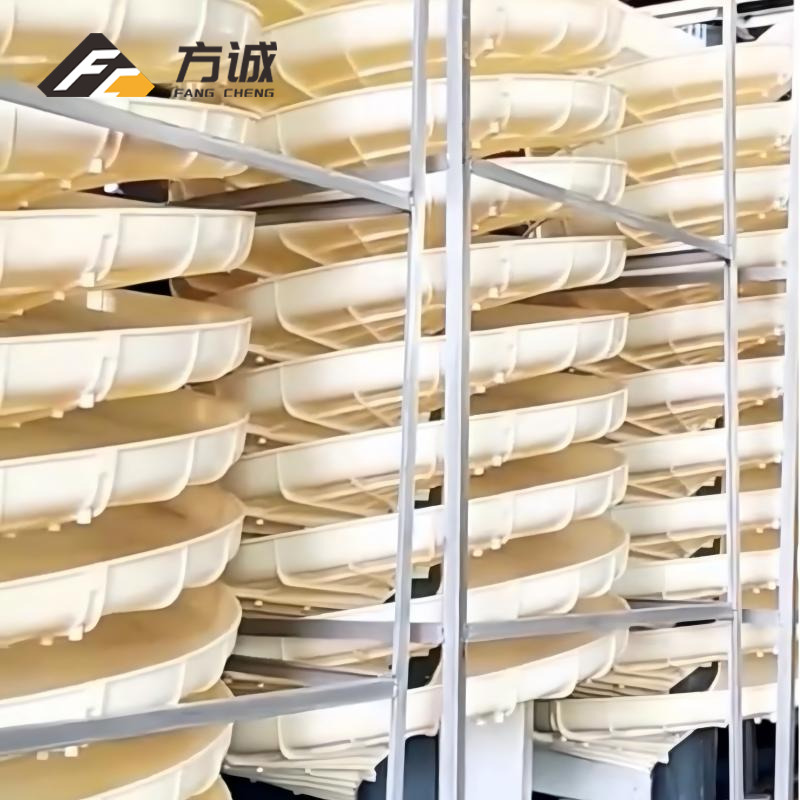
The ABS spiral chute has become an integral part of gravity separation circuits in modern beneficiation plants. It is often used in the following contexts:
Roughing and cleaning stages in tungsten and tin recovery
Pre-concentration before flotation or magnetic separation
Beach sand concentration for zircon, rutile, and monazite recovery
Fine mineral classification in tailings retreatment systems
By integrating multiple chutes in parallel or in series, processing plants can achieve large-scale continuous operation while maintaining precise control over concentrate quality.
In one mineral processing facility in Africa, engineers replaced traditional fiberglass spiral chutes with ABS spiral chute systems for fine tantalum-niobium recovery. The new setup achieved:
17% higher recovery rate
30% lower maintenance cost
50% reduction in installation time due to modular construction
These results clearly demonstrate the technology’s potential for industrial-scale mineral recovery, particularly in operations where fine particle control is critical.
The simplicity of the ABS spiral chute design makes operation easy. However, optimal performance depends on proper setup and maintenance:
Feed rate should remain steady to maintain laminar flow.
Water volume should be adjusted according to ore density and size.
Periodic cleaning is recommended to prevent slurry buildup.
Outlet position can be fine-tuned for different concentrate grades.
With correct operation, the chute can deliver stable, high-efficiency separation for many years.
The ABS spiral chute supports the mining industry’s shift toward sustainable development. Its energy-free operation, low maintenance demand, and recyclable materials contribute to lower carbon emissions and reduced environmental impact.
For investors and operators, these advantages translate to long-term cost savings, enhanced productivity, and compliance with green mining regulations.
Jiangxi Fangcheng Mining Equipment Manufacturing Co., Ltd. specializes in the R&D, manufacturing, and sales of mineral processing machinery. Its product range covers feeding, crushing, grinding, screening, flotation, gravity, magnetic, and drying equipment.
With decades of expertise and continuous innovation, Fangcheng has developed advanced polymer spiral chutes that deliver exceptional separation performance, durability, and cost efficiency. Each unit reflects the company’s commitment to providing reliable and sustainable mineral processing solutions for global mining enterprises.
Q1: What types of minerals can the ABS spiral chute process?
A1: It can process both metallic and non-metallic minerals, including iron, tungsten, tin, zircon, monazite, rutile, tantalum-niobium, and phosphate ores.
Q2: What materials are used to make the chute?
A2: The chute is constructed from high-performance polymers such as ABS, polyurethane, nylon, and polycarbonate alloy for superior wear resistance and strength.
Q3: How long does it take to install an ABS spiral chute?
A3: Thanks to its modular design, on-site installation can typically be completed within two hours after simple training.
Q4: Can it be customized for specific ore properties?
A4: Yes. Jiangxi Fangcheng offers design customization based on ore density, particle size, and plant layout to ensure optimal recovery.
Q5: What is the expected service life of the ABS spiral chute?
A5: Under normal operating conditions, it can last over 5 years—significantly longer than traditional fiberglass models.


