Views: 0 Author: Site Editor Publish Time: 2026-11-28 Origin: Site
Separating tin from tungsten presents a highly demanding metallurgical challenge in modern mineral processing. Cassiterite remains naturally non-magnetic, while wolframite exhibits only weak magnetic properties. Separating these two minerals, along with their associated iron impurities, requires incredibly precise magnetic gradients. When plant operators get these settings wrong, the negative business impact hits the bottom line immediately. Incorrect calibration leads directly to severe grade dilution. You risk losing valuable wolframite into the tailings or causing smelters to reject the final tin concentrate entirely.
This guide provides a strict technical framework designed specifically for process engineers and plant managers. You will learn how to properly optimize your current separation equipment to maximize recovery. We will also explore exactly what variables matter most when evaluating new separation technology for future plant upgrades. Mastering these parameters ensures a highly profitable yield and stabilizes your entire downstream processing circuit.
Optimal separation relies on a three-stage gradient: removing strong magnetics first, followed by medium and weak magnetics (tungsten), leaving clean tin.
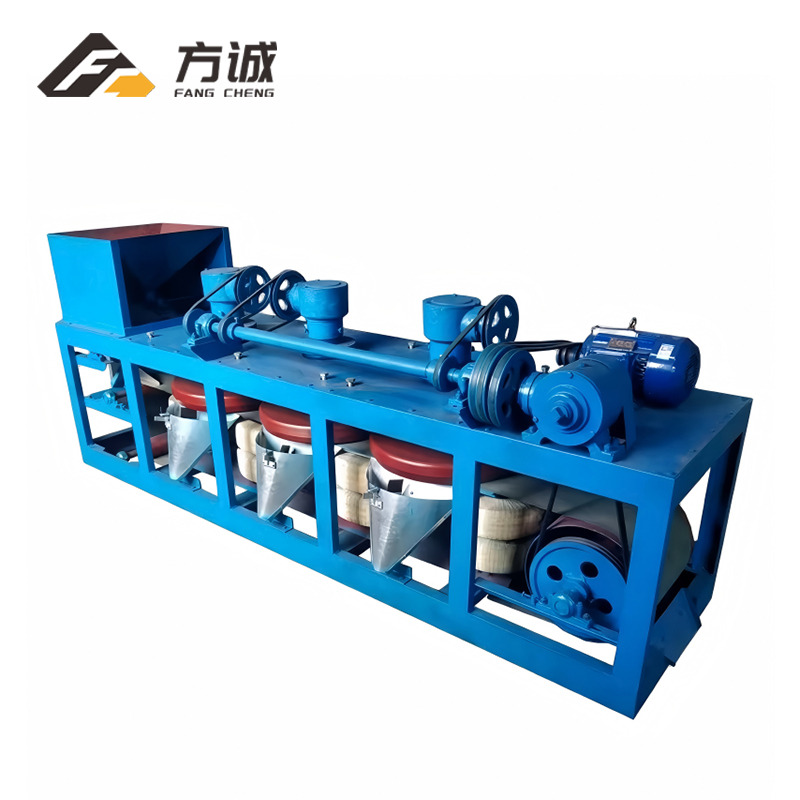
Precise three disc magnetic separator settings—specifically disc clearance and amperage—dictate the exact recovery-to-grade ratio.
Moisture content and particle size distribution (PSD) are the most common failure points in dry separation operations.
Evaluating a new magnetic separator requires assessing coil thermal stability, dust management compliance, and throughput scalability.
You must define clear operational targets based on mineral magnetic susceptibility before adjusting any equipment. Understanding how each mineral reacts to a magnetic field forms the foundation of your processing strategy. Tin, in the form of cassiterite, remains completely non-magnetic. Tungsten, found as wolframite, is weakly magnetic. Common impurities like magnetite and ilmenite are strongly magnetic. You must exploit these exact differences to achieve a clean separation.
Plant managers constantly face a strict yield versus grade trade-off. You must establish a realistic economic baseline for your specific ore body. Pushing aggressively for 99% tin purity often carries severe risks. You will likely sacrifice recoverable tungsten if the magnetic field becomes overly aggressive. A field set too high simply traps non-magnetic particles inside magnetic clusters. We recommend mapping out a recovery curve to find the most profitable balance point.
Feed preparation represents another critical success factor. Dry magnetic separation requires uncompromising moisture control. You should target a moisture content of less than 1%. Excess water creates capillary bridges between particles. These physical bridges bind tin and tungsten together, causing severe mechanical entrainment. Furthermore, you need a narrow particle size distribution. Large particles easily crush smaller ones against the conveyor belt. Proper sizing ensures each particle interacts with the magnetic field individually.
The mechanical adjustment of the distance between the rotating discs and the conveyor belt controls your baseline performance. We call this the disc clearance or air gap. Operators adjust this gap manually using threaded support rods. The golden rule of thumb is simple. Smaller gaps exponentially increase the magnetic field intensity acting on the ore. However, tight gaps risk severe physical jamming if your feed layer thickness becomes inconsistent. You must measure this gap using non-magnetic feeler gauges to ensure absolute precision.
Electrical current regulation directly alters the magnetic flux density for each specific disc. Higher amperage generates a stronger magnetic pull. Operators must calibrate the amperage independently for all three discs. Mastering these three disc magnetic separator settings allows you to target specific minerals sequentially. You should always document amperage changes in the daily shift log to track equipment performance trends over time.
Conveyor belt speed dictates how long particles remain exposed to the magnetic field. You must balance belt speed against centrifugal force. A belt moving too fast generates excessive centrifugal force. This physical force prevents the weakly magnetic tungsten from adhering to the disc surface. Conversely, a belt moving too slowly reduces your overall plant throughput.
Feed layer thickness requires strict operational discipline. A perfect monolayer presentation serves as the verifiable industry standard. A monolayer ensures every single particle touches the belt. If you stack particles too deeply, the top layer shields the bottom layer. The magnetic field will then pull up magnetic clusters, trapping non-magnetic tin inside them. Proper vibration feeders help maintain a consistent, flat monolayer presentation.
We execute the separation process through a precise, three-stage gradient. Each disc serves a highly specific metallurgical purpose.
Set the air gap relatively wide and the amperage low.
Target the removal of tramp iron and highly magnetic minerals like magnetite.
Clear these strong magnetics early to prevent downstream blinding.
Monitor the discharge chute to ensure no valuable wolframite gets pulled prematurely.
The primary goal here is equipment protection. Removing strong magnetics prevents them from physically clogging the tighter gaps on subsequent discs.
Lower the disc clearance slightly and increase the electrical current.
Calibrate the field to extract moderately magnetic impurities.
Focus on removing troublesome minerals like ilmenite or garnet.
Inspect the tailings visually to confirm clean extraction.
Your goal is protecting the final tungsten grade. Cross-contamination from ilmenite severely degrades the commercial value of your tungsten concentrate. Catching it here secures your profit margins.
Drop the air gap to its safest minimum operating distance.
Push the amperage to its maximum sustainable limit without overheating.
Execute the critical magnetic field adjustment to capture the weakly magnetic wolframite.
Verify that the non-magnetic cassiterite continues cleanly off the end of the belt.
This final stage defines your operational success. Maximizing tungsten recovery here while producing a clean tin product is the ultimate goal of dry magnetic separation tin ore processing. Operators must monitor this specific disc continuously throughout the shift.
Thermal drift in magnetic coils threatens continuous production stability. Prolonged operation inherently heats the copper electromagnets. As temperature rises, electrical resistance inside the coils increases. If your voltage remains constant, this higher resistance forces the electrical current to drop. Consequently, your magnetic field intensity weakens significantly mid-shift. Operators often notice a sudden drop in tungsten recovery. You must monitor coil temperatures and manually adjust amperage to compensate for this thermal drift.
Dust accumulation causes severe mechanical wear across the machine. Mineral dust acts as an aggressive abrasive. It works its way into unprotected bearings and coats the disc teeth. Over time, rounded disc teeth lose their ability to concentrate the magnetic flux lines effectively. We recommend implementing a strict daily cleaning protocol. Use compressed air to blow out dust from critical moving parts at the end of every production shift.
Feed variations constantly disrupt separation efficiency. You must troubleshoot upstream crushing and grinding circuits vigorously. Over-grinding produces excessive fine particles. Fine tin behaves unpredictably on the conveyor belt. Static electricity can cause fine tin to stick to the belt or mechanically carry over into the magnetic fraction. If you detect off-spec particle sizes, halt the separator immediately. Adjust your upstream screen decks before resuming the separation process.
Plant managers must eventually decide when to calibrate existing equipment versus replacing it entirely. We use a simple decision framework. If your current machine suffers from severe thermal drift within two hours of startup, the coils are likely degraded. If the machine cannot maintain a consistent air gap under a normal load due to structural warping, calibration will fail. In these scenarios, replacement becomes vastly more viable than enduring continuous maintenance downtime.
Feature-to-Outcome Assessment Framework
Equipment Feature | Production Outcome | Evaluation Criteria |
|---|---|---|
Oil Cooling Systems | Maintains consistent magnetic field intensity during long shifts. | Compare the thermal stability curve of oil-cooled coils versus traditional air-cooled coils. |
Variable Frequency Drives (VFD) | Allows real-time belt and disc speed control. | Check for integrated PLC controls that allow operators to fine-tune centrifugal forces instantly. |
High-Gradient Magnetic Nodes | Improves recovery of ultra-fine wolframite particles. | Assess the physical geometry of the disc teeth for optimal flux concentration. |
You must evaluate any modern tungsten magnetic separator based on its coil cooling efficiency. Sustained magnetic field strength guarantees consistent recovery rates. VFD integrations are equally vital. They empower operators to respond to changing ore characteristics instantly without stopping the belt.
Scalability and compliance dictate long-term operational viability. Consider your future throughput capacity limitations. A standard 3-disc setup processes specific volumes effectively. However, if your mine plan doubles production next year, you might require multi-stage high-gradient magnetic separation (HGMS) alternatives. An undersized machine forces operators to run the belt too fast, ruining recovery rates.
Compliance with occupational health and safety (OHS) standards remains non-negotiable. Ensure the selected Magnetic Separator integrates seamlessly with your facility's dust extraction systems. Dry separation generates hazardous silica dust. The equipment housing must support active negative-pressure extraction to protect your workforce.
Effective tin and tungsten separation requires a continuous balancing act of gap distance, field intensity, and feed consistency.
Operators must maintain strict moisture control and ensure a precise monolayer feed presentation to prevent mechanical entrainment.
Address thermal drift proactively by monitoring coil temperatures and adjusting amperage to sustain target recovery rates mid-shift.
Prioritize robust process control and baseline testing before committing to full-scale production adjustments or major capital expenditure.
Evaluate new equipment based on cooling efficiency, real-time control features, and seamless dust extraction integration.
A: The ideal particle size typically ranges from 0.1mm to 2mm. Particles larger than 2mm can physically jam the tight air gaps required on the third disc. Conversely, excessive fines below 0.1mm lead to poor separation efficiency. Fine particles agglomerate easily, causing non-magnetic tin to be mechanically carried into the magnetic tungsten fraction.
A: Operators should perform visual checks every shift to ensure uniform feed distribution. You must verify the amperage and air gap settings daily. Calibration frequency should increase immediately if the upstream ore body characteristics change. Regular calibration prevents thermal drift from secretly degrading your tungsten recovery rates during continuous operation.
A: High tin levels usually result from mechanical entrainment rather than magnetic attraction. This typically occurs when your feed layer is too thick, preventing a proper monolayer. The magnetic tungsten traps the non-magnetic tin as it pulls upward. Alternatively, an overly aggressive magnetic field on the third disc can force clusters of mixed material to stick together.