


Views: 0 Author: Site Editor Publish Time: 2026-11-10 Origin: Site


Gravity separation efficiency relies entirely on matching your physical equipment to the feed's particle size distribution. You cannot afford to guess when configuring your mineral processing circuit. Mineral variations demand precise hydraulic sorting.
Deploying the wrong deck type on a shaking table causes immediate losses. Heavy minerals will quickly wash into the tailings. Alternatively, excessive light gangue will contaminate your final concentrate. Either scenario directly harms your metallurgical recovery and plant profitability. You must select the right surface profile for your specific ore.
We will explore how to properly match your feed to the correct equipment. This article provides a strictly technical, decision-focused framework for evaluating different deck configurations. You will learn the exact parameters required to choose between coarse, fine, and slime decks for your mineral processing circuits.
The primary differentiator between 6S shaking table deck types is the riffling design (depth, spacing, and length), which must strictly align with feed particle size.
A coarse sand shaking table maximizes throughput for 0.5mm–2.0mm particles but will aggressively wash away fine gold or heavy minerals.
A fine sand shaking table balances capacity and recovery for 0.074mm–0.5mm feed, requiring tighter water control.
Slime deck selection is reserved for ultra-fine materials (0.037mm–0.074mm), offering high recovery but operating at significantly reduced capacities.
Strict upstream feed classification (sizing) is non-negotiable; unclassified feed guarantees poor separation regardless of the deck chosen.
Improper deck selection creates severe operational bottlenecks. Plants suffer lower metallurgical recovery and reduced profitability. Upstream energy spent crushing and grinding rock becomes wasted effort. If the gravity circuit cannot capture the liberated minerals, you lose money. Operators must approach deck selection as a critical metallurgical decision.
Successful gravity concentration requires three elements. First, you need an optimal concentration ratio. Second, you must hit your target recovery percentage. Finally, you need a predictable, stable throughput. Achieving these goals demands a perfect match between ore particles and deck geometry.
The anatomy of a deck dictates how minerals separate. Riffle geometry on the fiberglass or wooden surface controls the settling dynamics. These raised ridges trap heavy minerals. They also transport them laterally toward the concentrate edge. Meanwhile, a cross-flow of wash water pushes lighter gangue particles down the slope. Every Shaking Table relies on this delicate balance of forces.
A single shaking table cannot efficiently process a broad particle size distribution. You cannot run a mixed 0-2mm feed on one deck. Hydraulic sorting physics prevent this. Coarse light particles behave similarly to fine heavy particles in a water film. They will mix together and ruin your separation grade. You must divide the feed into narrow size fractions.
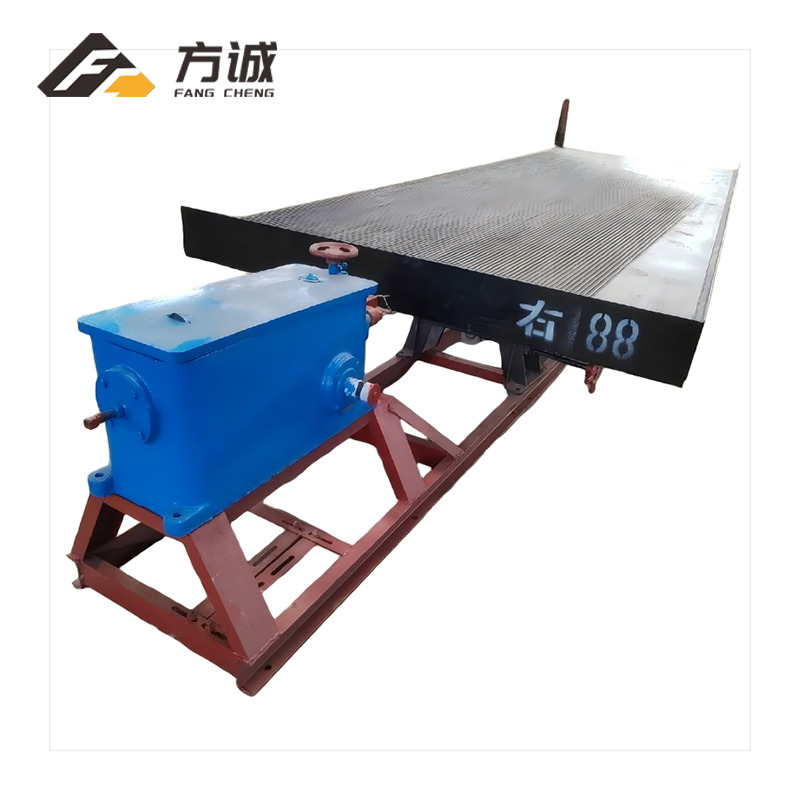
Coarse feed requires aggressive agitation. Operators must manage larger volumes of material without losing heavy particles. The coarse sand shaking table handles this challenge efficiently.
Target Particle Size: This deck processes particles from 0.5mm to 2.0mm. This range roughly equals 10 mesh to 35 mesh. Anything larger typically requires a jig separator.
Riffle Profile: The deck features deep, widely spaced riffles. These robust ridges agitate larger beds of material. They create enough turbulence to keep light gangue in suspension. Heavy, coarse particles can then settle firmly against the deck surface.
Operational Capacity: This configuration offers the highest throughput among the three options. You can typically process 1.5 to 2.5 tons per hour per table. The exact rate depends heavily on the specific gravity of your ore.
Ideal Applications:
Placer gold roughing circuits.
Coarse tin and tungsten recovery.
Primary gravity circuits immediately following a rod mill.
Processing coarse grind discharges.
Limitations: Coarse decks are highly inefficient for fine particles. They require high wash water velocity to move large gangue particles. This aggressive water flow will instantly carry fine gold into the tailings launder. Never use a coarse deck to capture liberated fines.
Mid-range particle processing demands a balanced approach. You need moderate agitation and careful water control. The fine sand shaking table excels in this exact scenario.
Target Particle Size: We target particles from 0.074mm to 0.5mm. In screen sizes, this spans from 200 mesh to 35 mesh.
Riffle Profile: Fine sand decks utilize moderate depth and spacing. The riffles cover less surface area compared to coarse decks. This design leaves a larger unriffled "cleaning" zone near the concentrate discharge. The smooth zone allows final washing of the concentrate band. It ensures high-grade output.
Operational Capacity: Expect a moderate throughput. Operators typically run 1.0 to 1.5 tons per hour on a standard 6S table. Pushing past this limit forces heavy minerals into the middlings or tailings.
Ideal Applications:
Scavenging circuits catching escaped minerals.
Secondary grinding stage gravity recovery.
Recovering liberated minerals from ball mill discharge streams.
Cleaning rougher concentrates from spirals or jigs.
Limitations: These decks are highly vulnerable to surging. They require steady, consistent feed density. You must highly regulate the wash water pressure. Pressure spikes will instantly destroy the separation line. We strongly recommend installing a dedicated constant-head water tank to feed these tables.
Recovering ultra-fine heavy minerals tests the limits of gravity separation. Fluid dynamics easily overpower gravity at this scale. Proper slime deck selection requires understanding laminar flow.
Target Particle Size: Slime decks target particles between 0.037mm and 0.074mm. This incredibly fine material ranges from 400 mesh to 200 mesh.
Riffle Profile: They use very shallow, closely spaced riffles. Operators sometimes call this a "smooth deck" due to its minimal grooving. The design strictly minimizes hydraulic turbulence. Ultra-fine heavy particles must cling gently to the deck surface. Deep riffles would create eddies that wash these particles away.
Operational Capacity: Slime decks offer the lowest throughput. You can only process 0.5 to 0.8 tons per hour. Slow feeding allows the micro-particles enough time to settle through the water film.
Ideal Applications:
Tailings retreatment projects.
Ultra-fine gold recovery from oxidized ores.
Processing slimes generated from hydrocyclone overflows.
Limitations: These decks exhibit extreme sensitivity. Minor fluctuations in wash water will ruin the process. A slight change in table tilt will disrupt the separation bed. Even a tiny feed rate surge causes losses. Because of the low throughput, commercial plants require a high number of units. This demands substantial floor space to achieve plant-level scale.
Selecting 6S shaking table deck types requires a structured evaluation. You must base your decision on empirical data. Relying on visual estimates of ore sizes leads to poor equipment choices.
Table 1: Summary of 6S Shaking Table Deck Profiles
Deck Type |
Target Particle Size |
Capacity (tph) |
Riffle Profile |
|---|---|---|---|
Coarse Sand |
0.5mm – 2.0mm |
1.5 – 2.5 |
Deep, widely spaced |
Fine Sand |
0.074mm – 0.5mm |
1.0 – 1.5 |
Moderate, large cleaning zone |
Slime |
0.037mm – 0.074mm |
0.5 – 0.8 |
Shallow, closely spaced |
This is the foundational metric for your circuit. Decision-makers must rely on accurate sieve analysis. Test the actual ore body samples. Do not rely on assumptions or general regional geology. A detailed PSD report will tell you exactly what percentage of your feed falls into coarse, fine, and slime categories. Allocate your deck procurement accordingly.
You must address the inverse relationship between volume and recovery. A coarse deck scales incredibly well for volume processing. However, it sacrifices fine mineral recovery entirely. Slime decks maximize recovery of fine gold. Yet, they require massive floor space for multiple units to handle commercial tonnage. You must balance your capital expenditure for space against the value of the recovered fine minerals.
Always evaluate your site conditions carefully. Fine and slime decks require absolutely clean, pressurized wash water. Suspended solids or clay in the wash water will ruin fine separation. Muddy water alters the fluid viscosity. This prevents ultra-fine heavy minerals from settling. If clean water is scarce, you must install clarifiers before routing water to your slime decks.
Compare fiberglass against traditional wood or rubber linings. Modern fiberglass decks serve as the industry standard. They resist chemical degradation and weigh less. They also hold riffle shapes perfectly over time. Wood and rubber linings offer advantages only for specific highly abrasive ores. In most gold and tin applications, fiberglass provides superior longevity and separation clarity.
Buying the correct deck solves only half the problem. Installation and upstream preparation dictate final performance. Gravity circuits punish operational shortcuts severely.
Shaking tables remain highly sizing-sensitive. They do not just separate by density. You must mandate the use of hydraulic classifiers upstream. Hydrocyclones or hindered settling classifiers work best. They provide a tightly sized feed to each table group. Feeding unclassified material to a high-precision table guarantees failure. Coarse quartz will physically knock fine gold off the table.
Operators frequently push feed rates beyond the deck's specific capacity. This practice yields disastrous results. The mineral bed packs tightly. Stratification stops completely. Heavy minerals cannot burrow down to the deck surface. They ride over the packed bed and wash into the tailings. Always respect the tonnage limits outlined for your specific deck type.
Selecting the right deck is only step one. Operators must adjust the eccentric head motion to match the particle size. Slime decks require shorter, faster strokes (typically 10mm to 14mm). This gentle vibration coaxes ultra-fine particles along. Coarse sand decks need longer, slower strokes (typically 18mm to 22mm). The longer throw aggressively moves large, heavy particles forward.
Never underestimate installation risks. A shaking table requires an absolutely rigid, perfectly level concrete foundation. The separation bands rely on millimeter-perfect water sheets. Structural vibration from nearby crushers directly negates the value of a high-precision deck. If the floor shakes, the mineral bed collapses. Pour deep, isolated concrete pads for your gravity room.
The 6S shaking table deck types serve as specialized metallurgical tools. They require strict alignment with your upstream milling and classification outcomes. Matching riffle geometry to particle size remains the absolute rule for gravity success.
Use verifiable sieve data to group your procurement decisions. Specify coarse decks for material larger than 0.5mm. Order fine decks for mid-range particles. Reserve slime decks exclusively for material finer than 0.074mm. This logic eliminates guesswork.
Your next step should involve empirical validation. Advise your procurement teams or plant managers to conduct pilot-scale gravity testing. Test your specific ore body before calculating the final table count. Real-world testing secures your capital investment and ensures you purchase the exact deck mix your circuit requires.
A: No. Processing unclassified feed leads to coarse light minerals physically displacing fine heavy minerals. The large gangue particles create excessive turbulence in the water film. This results in poor concentrate grade and extremely high tailings loss. You must classify feed before gravity concentration.
A: Coarse decks have deep, wide, and long riffles to manage larger volumes of heavy material. Slime decks utilize incredibly shallow, short riffles. The shallow design gently coaxes ultra-fine particles toward the concentrate edge without causing hydraulic turbulence.
A: Coarse decks can process up to 2.5 tph. Fine sand decks average 1.0–1.5 tph. Slime decks are typically restricted to 0.5–0.8 tph. Lower throughput on slime decks is mandatory to maintain recovery efficiency for ultra-fine particles.
A: Yes. The channel steel support and eccentric head mechanism are standard across configurations. The fiberglass decks are modular. Maintenance teams can swap them out easily if the plant's grind size or target mineralogy permanently changes.


