Views: 0 Author: Site Editor Publish Time: 2026-09-30 Origin: Site
Sizing your extraction equipment represents one of the most critical financial decisions for any mining operation. Mismatched processing capacity inevitably leads to serious operational issues. You either waste valuable capital expenditure by oversizing, or you face significant gold loss to the tailings through undersizing and bottlenecking. Effective sizing demands a comprehensive evaluation of your entire flow sheet. You must assess the journey from raw gravel excavation down to the final clean-up room. Isolating individual machines often masks underlying system inefficiencies and fluid dynamic problems. We will introduce a structured framework below to solve this challenge. This guide helps you match target feed rates, measured in Tons Per Hour (TPH) or Cubic Yards Per Hour (CYPH), with precise equipment capabilities. You will learn how to balance material volume, water requirements, and recovery mechanisms to build a highly efficient processing plant.
Equipment manufacturers frequently list maximum capacities recorded under ideal test conditions. Buying machinery based solely on these nameplate ratings routinely causes severe operational bottlenecks. Real-world processing capacity strictly depends on your specific material characteristics.
Volume versus weight metrics confuse many operators. Sizing starts with accurately converting Loose Cubic Yards (LCY) to Tons Per Hour (TPH). Moisture content and bedrock types dramatically alter the feed weight. A yard of dry, clean gravel weighs much less than a yard of wet, clay-bound material. You must understand these variations before selecting equipment.
Material Conversion Baselines (LCY to TPH)
| Material Type | Moisture Level | Estimated Weight (Tons per LCY) |
|---|---|---|
| Clean Gravel | Dry | 1.35 |
| Clean Gravel | Wet | 1.50 |
| Clay-Bound Gravel | Wet | 1.65 - 1.80 |
You must also account for surge loading. Excavators and wheel loaders deliver material in massive, uneven batches. This dumping action creates severe spikes in your processing line. Feeder control solves this specific issue. Installing and correctly sizing a vibrating grizzly feeder stabilizes erratic inputs. It ensures your downstream machinery receives a steady, predictable flow of material.
Finally, you need to evaluate the "clay factor." High-clay deposits demand significantly longer retention times inside your scrubbers. Clay binds fine gold tightly. You must break it down completely before classification. This necessary washing time effectively lowers your true feed rate capacity. A machine rated for 100 TPH in clean gravel might only process 60 TPH in heavy clay. Maintain realistic baseline metrics to prevent downstream failures.
Your primary processing stage heavily influences the success of your entire operation. You must carefully match raw earthmoving capacity to this initial classification step. If you feed dirt faster than the system can wash it, you lose gold immediately.
Operators frequently debate between using trommels and vibrating screens. You should evaluate sizing criteria for a placer gold wash plant based on your specific deposit profile. Trommels utilize diameter and length to calculate retention time. They excel at processing sticky, clay-rich materials. Conversely, vibrating screens use deck surface area for sizing calculations. They work exceptionally well for high-tonnage, relatively clean gravels.
Water volume requirements present another critical dependency. You cannot ignore the relationship between target feed rate and available water supply. Industry standards typically measure this ratio in Gallons Per Minute (GPM) per yard of material. Undersized water pumps will severely throttle even the most highly rated plant.
Follow these primary sizing steps:
Early oversize rejection impacts your efficiency heavily. You must calculate the exact percentage of oversized material you expect to discard. Removing rocks larger than 1/2 inch immediately reduces the actual feed rate moving forward. This strategy significantly lightens the load reaching your secondary recovery stage. It prevents unnecessary wear and optimizes the slurry volume for fine extraction.
You now face the challenge of managing the classified slurry. The feed rate dropping into this stage is significantly lower than your raw mine input. However, this fluid flow remains highly dynamic.
Sluice box hydraulics require careful mathematical evaluation. You should size a placer gold sluice primarily by its width rather than just its length. Higher feed rates demand wider sluices. You must maintain a shallow, smoothly controlled slurry flow across the riffles. Excessive velocity creates destructive turbulence. This turbulence acts like a vacuum, lifting and blowing ultra-fine gold straight into the tailings pile.
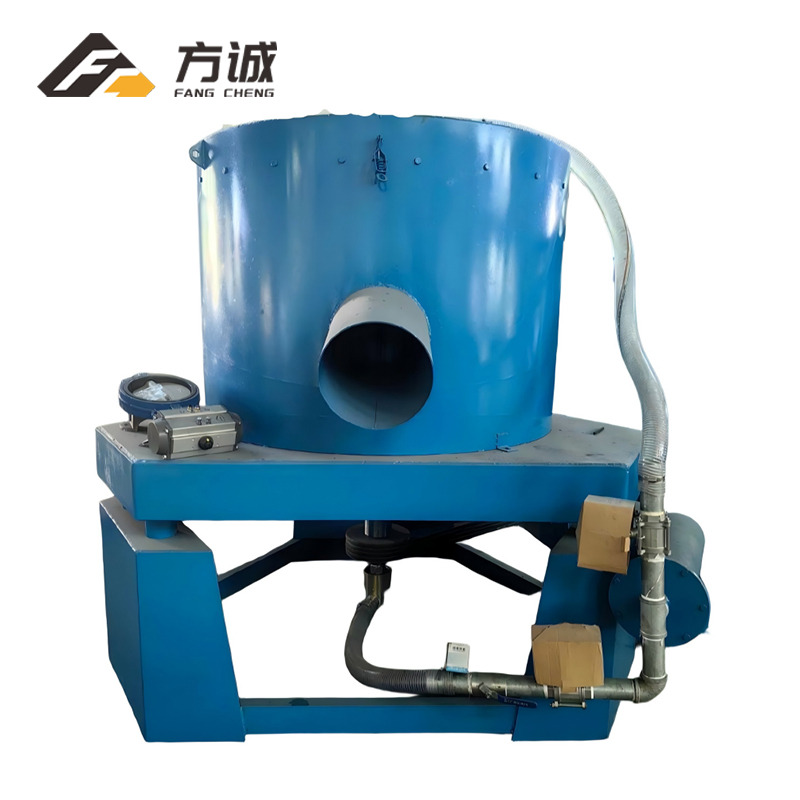
Centrifugal upgrading offers a high-tech alternative for massive volumes. When evaluating a fine gold concentrator, you look at distinct technical parameters. You must match the fluidization water pressure and G-force capabilities to your specific operational tonnages. High G-forces pin micron-sized gold particles against the bowl ridges. Meanwhile, precisely calibrated fluidization water keeps lighter black sands suspended and flowing out to waste.
Exceptionally high feed rates often require parallel processing logic. You might consider running multiple mid-sized concentrators side-by-side rather than buying one massive unit. This modular approach provides several distinct advantages:
Balancing velocity, volume, and recovery mechanisms prevents you from losing your most valuable micron-sized gold.
Your focus must shift dramatically when sizing the clean-up stage. You size this room strictly based on the concentration ratio of your primary recovery equipment. You should never base it on the raw mine feed rate.
First, evaluate whether your daily concentrate volumes demand continuous automated upgrading or manual batch processing. Continuous processing fits massive commercial mines running 24/7. Manual batch processing works perfectly for operations generating smaller, manageable amounts of black sand each shift.
Matching your final table to the actual yield prevents severe overcapitalization. A massive 200 TPH raw earth wash plant usually generates a surprisingly small amount of heavy concentrate. You might only produce a few hundred pounds of dense black sand per day. Therefore, you rarely need industrial-scale secondary plants here.
A relatively compact, high-precision gold shaking table easily handles these reduced volumes. You feed the table slowly to ensure maximum separation between the heavy gold and the lighter waste minerals. If you try to push too much volume across a small finishing table, the concentrate bed deepens rapidly. This buries the fine gold and sweeps it directly off the table edge. Sizing this equipment correctly ensures you capture every ounce you worked so hard to mine.
High-capacity equipment introduces severe implementation risks. You might find massive machinery requires infrastructure simply unavailable in remote locations. You must carefully consider logistical limitations before finalizing your equipment purchases.
Power and water constraints often dictate your maximum viable feed rate. Scaling up your processing volume exponentially increases your daily water consumption. This forces you to assess the massive footprint required for settling ponds and water clarification systems. Environmental compliance acts as a hard boundary here. Regulatory bodies heavily monitor wastewater discharge and turbidity levels. You cannot size a plant for 300 TPH if your local watershed permits only support a 100 TPH closed-loop system.
Long-term mine planning requires strategic foresight. If you map out a 10-year horizon, modular placer gold mining equipment usually wins out. Over-capitalizing on day one severely drains cash reserves. Adding secondary processing lines as your pit expands represents a much safer financial approach.
Common Mistakes to Avoid:
You build true resilience into your operation by planning for staged growth and prioritizing environmental compliance from the very start.
Sizing your mining equipment correctly requires a sequential, mathematical approach. You must follow a strict shortlisting logic to optimize recovery. First, define your target raw feed based on your earthmoving limits. Next, determine your primary wash plant capacity while factoring in clay retention and water metrics. Calculate the reduced classified slurry volume to size your primary recovery units properly. Finally, estimate your daily concentrate yield to select the exact right clean-up equipment.
Do not finalize your equipment sizing matrix purely on guesswork. We highly recommend consulting with metallurgical engineers first. You should conduct extensive bulk sample testing on your specific claim. These tests reveal the exact clay content, gold particle size distribution, and heavy mineral ratios. You can then confidently purchase properly scaled equipment, ensuring maximum efficiency and profitability for your site.
A: No. Pushing more material through your plant often decreases overall yield. If your recovery equipment is not strictly sized to handle the increased velocity and slurry volume, fine gold gets blown out into the tailings. Processing efficiency always trumps sheer dirt volume. Capturing 95% of a smaller volume yields far more profit than capturing 40% of a massive volume.
A: Clay demands aggressive scrubbing and extended retention time. You cannot rush this process. You must either intentionally reduce your hourly feed rate or purchase an oversized primary wash plant. Using longer trommels equipped with scrubber sections ensures the clay breaks down fully before hitting your sluices.
A: Water needs vary by material, but a general benchmark exists. You typically need roughly 1,500 to 3,000 gallons per minute (GPM) for a standard 100-yard-per-hour wash plant. However, recycling systems and the size of your settling ponds heavily dictate your actual continuous water draw.
A: You should transition when your target feed rates exceed what a traditional sluice width can manage safely. If bulk sampling proves your deposit contains a high percentage of sub-100 mesh gold, sluices will struggle. Centrifugal concentrators trap this ultra-fine gold efficiently at much higher slurry volumes.