Views: 0 Author: Site Editor Publish Time: 2026-06-18 Origin: Site
Maximizing recovery rates in alluvial and hard-rock operations hinges on matching the right gravity separation technology to your specific ore characteristics. Every mineral body behaves differently. For tin (cassiterite) and gold recovery, relying on assumptions rather than metallurgical data is dangerous. It leads to lost yield in the tailings. It can also inflate your operational expenditures (OPEX) unnecessarily. Accurate equipment selection ensures higher purity and lowers long-term processing costs.
Evaluating tin and gold mining equipment requires moving beyond basic spec sheets. You must understand the physical constraints of your site. This guide breaks down the metallurgical realities of density-based separation. We explore the operational trade-offs and ROI implications. You will learn the distinct differences between deploying a jig and a shaking table.
Our goal is helping plant managers make evidence-based procurement decisions. We will discuss particle size matrices, circuit integration, and practical flowsheet realities. By applying these engineering principles, you can optimize your processing plant. You will maximize throughput without sacrificing concentrate purity.
Feed Size Dictates the Tool: Jig concentrators excel at high-throughput roughing for coarse particles (1mm to 20mm), while shaking table separators are essential for precision cleaning and fine particle recovery (down to 0.037mm).
Resource Constraints Matter: Jigs require significant, continuous water flow; shaking tables demand a larger physical footprint and highly stable foundations.
Circuit Synergy: In optimal gravity separation mining setups, these machines rarely compete directly; they act sequentially, often integrated with spiral chutes to form a comprehensive recovery circuit.
ROI Focus: Selection should be driven by the specific gravity differential of the target ore, available site footprint, and the skill level of local operators.
Plant managers face a relentless dual challenge. You must process high-volume feed efficiently. Simultaneously, you must ensure micro-fine gold or tin isn't lost to the tailings. Balancing these goals is difficult. Heavy minerals behave unpredictably in poorly designed circuits. If you push too much tonnage, your recovery drops sharply. If you focus solely on concentrate purity, your throughput suffers.
To build a profitable plant, you must define strict success criteria. Industry standards dictate evaluating three primary metrics before purchasing equipment:
Target recovery rates based on head grade and laboratory testing.
Throughput capacity constraints, usually measured in Tons Per Hour (TPH).
Concentration ratio requirements necessary for downstream processing or direct smelting.
The core mechanism driving gravity separation mining is density differential. Gold carries a massive specific gravity (SG) of 19.3. Tin, in the form of cassiterite, sits between SG 6.8 and 7.1. Common gangue minerals, like quartz or feldspar, hover around SG 2.6. This stark difference in density makes separation highly effective. However, effectiveness relies entirely on proper particle liberation. If your crushing circuit leaves gold locked in quartz, the density differences narrow. You must match your separation tool to the specific gravity and the liberated feed size.
Understanding how a jig concentrator works is essential for bulk processing. These machines rely on a principle called hindered settling. A mechanical diaphragm creates hydraulic pulsation. It pushes water up and down through a screen. This action creates a stratified bed within the machine. Heavier target minerals penetrate the artificial ragging layer. They then settle into the hutch below. Meanwhile, lighter gangue washes over the discharge weir.
Jigs shine in specific application scenarios. They are the undisputed champions of primary roughing. Many operations use them for alluvial gold and placer tin deposits. They easily process unclassified river gravels. Jigs also excel at pre-concentration. In hard-rock setups, jigs remove barren rock before costly milling processes. This early rejection dramatically reduces your downstream grinding OPEX.
When deploying jigs, you must face certain implementation realities. You will encounter clear advantages and distinct risks. Let us examine them:
Pros: They offer enormous throughput capacity. They handle fluctuating feed grades exceptionally well. They are mechanically robust and relatively simple to operate.
Cons: Jigs demand high, continuous water consumption. They are highly ineffective for ultra-fine particle recovery. Operators require skill to manage stroke length and frequency. Incorrect hutch water pressure will instantly ruin your recovery rates.
You must continuously monitor the ragging bed depth. Common ragging materials include steel shot or coarse hematite. If the bed compacts, heavier particles cannot penetrate. If it becomes too loose, lighter gangue falls into your concentrate. Maintaining bed porosity is a critical daily operational task.
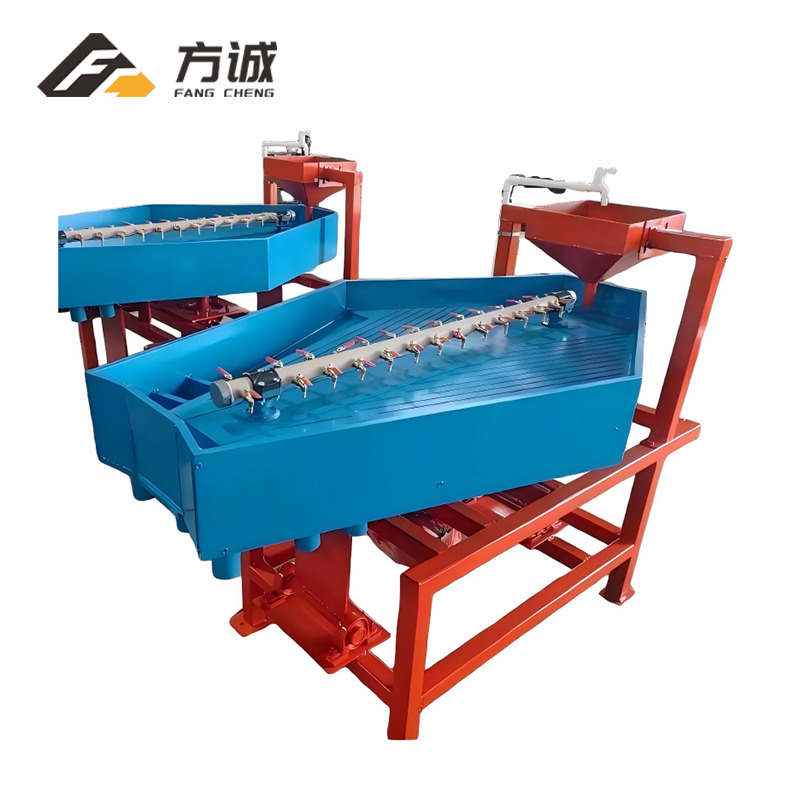
When processing fine feeds, you need precise control. The shaking table separator provides exact metallurgical precision. It operates using flowing film concentration. The table utilizes an asymmetrical reciprocating motion. The deck moves forward slowly and snaps back quickly. A thin film of wash water flows across the riffled deck. This combination separates particles horizontally and vertically. Heavy particles walk along the riffles. Lighter gangue washes perpendicularly over them.
These machines fit specific niches in your plant. They dominate the final cleaning stages. You use them to upgrade rougher concentrates into a smeltable product. You can achieve direct smelting grades easily. They also act as exceptional scavengers. Many plants deploy them to catch fine gold or tin escaping into tailings streams.
Like any equipment, tables come with realities and risks. You must evaluate the trade-offs carefully:
Pros: Tables deliver an extremely high concentration ratio. They create distinct, visible separation bands. This visibility allows for real-time operator adjustments. They boast excellent fine particle retention down to 37 microns.
Cons: They suffer from very low throughput per unit. Scaling up capacity requires a massive floor footprint. They are highly sensitive to feed density fluctuations. A shaky foundation will completely destroy their separation efficiency.
Best practices dictate maintaining a constant feed density. Surges in feed volume will ruin your recovery. Fluctuations in wash water pressure will disrupt the separation bands. A stable concrete foundation is non-negotiable. Vibrations from nearby crushers will blur the concentrate lines on your deck. You must isolate your tables from heavy plant vibration.
Comparing these machines requires analyzing multiple engineering dimensions. You cannot select equipment based on price alone. Let us break down the core evaluation metrics.
The particle size matrix is your first filter. The coarse fraction, usually above 2mm, demands a jig. Jigs dominate coarse recovery effortlessly. Conversely, the fine fraction below 1mm makes a table a necessity. Jigs lose efficiency rapidly as particles shrink. The turbulence inside a jig washes fine gold away. Tables capture these fines beautifully.
Next, consider CAPEX and OPEX. Initial equipment costs represent only a fraction of your budget. Installation costs for tables are surprisingly high. They require thick, isolated concrete pads. Otherwise, environmental vibrations disrupt the deck. Energy consumption per ton of ore processed heavily favors jigs. Jigs move massive tonnage quickly. This lowers your relative electrical costs per ton.
Scalability and footprint introduce stark spatial realities. Adding 50 TPH capacity with jigs requires minimal space. You just add a few vertical machines. Doing the same with shaking tables requires an entire warehouse floor. You need dozens of tables to match one large rougher jig.
Evaluation Dimension | Jig Concentrator | Shaking Table Separator |
|---|---|---|
Optimal Feed Size | 1mm to 20mm (Coarse) | 0.037mm to 2mm (Fine) |
Capacity (Throughput) | High (up to 50+ TPH per unit) | Low (0.5 to 2 TPH per unit) |
Footprint Requirement | Compact, vertical orientation | Massive, large horizontal floor space |
Primary Plant Role | Roughing / Pre-concentration | Final Cleaning / Scavenging |
Operational Sensitivity | Low sensitivity to feed surges | High sensitivity to feed/water changes |
Finally, water management strategies differ greatly. Both systems demand water. However, comparing their closed-circuit recycling needs reveals distinct profiles. Jigs require high-pressure hutch water. Tables require a gentle, consistent wash water film. Your plant must engineer pump and pipe sizing accordingly. Water clarifiers are essential for both systems. Muddy wash water will ruin table visibility and efficiency.
Modern processing flowsheet reality dispels the "either/or" myth. You rarely choose one machine over the other. The best plants combine mineral separation equipment to build synergistic circuits. They rely on sequential processing.
Most commercial operations follow a strict sequence. They use jigs for immediate bulk volume reduction. The jig acts as a gatekeeper. It throws away bulk gangue early in the process. The enriched concentrate then passes downstream. The table receives this smaller, upgraded volume. It performs the final concentrate upgrading. This sequence maximizes plant throughput and product purity simultaneously.
A complete flowsheet often incorporates a spiral chute. Where does the spiral fit? It typically serves as an intermediate step. It bridges the gap between the jig and the table. Spirals handle mid-tier particle sizes efficiently. They operate entirely via gravity. They require zero moving parts. This drastically lowers plant OPEX. You route the jig tailings or midlings to the spiral. The spiral then feeds its upgraded concentrate to the table.
Managing slimes and fines dictates overall circuit success. Neither jigs nor tables handle clay or slimes well. Slimes increase fluid viscosity artificially. This prevents heavy minerals from settling properly. Upstream preparation is absolutely mandatory. You must employ hydrocyclones, scrubbers, or trommels. They wash and classify the ore before it reaches your gravity circuit. Removing ultra-fines ensures your primary separation machines operate at peak metallurgical efficiency.
Selecting the correct machinery requires a disciplined decision matrix. Do not rely on gut feelings. Let your specific ore body constraints guide you. You must base decisions on empirical metallurgical data.
Apply this basic logic matrix to start your shortlisting process. If you face high capacity demands and coarse feed, prioritize jigs. They will chew through tonnage rapidly. They deliver excellent early-stage volume reduction. If you handle low capacity, high grade, and fine feed, prioritize tables. They will secure your valuable fine gold or tin.
Evaluating manufacturer claims is a critical procurement step. You must scrutinize vendor specification sheets intensely. Generic recovery rate promises are marketing fluff. An 80% recovery rate on free-milling quartz gold differs from an 80% rate on complex sulfide gold. Demand empirical metallurgical test work. A reputable supplier should model their equipment claims against your actual ore type.
Your next steps for procurement should focus on validation. Follow these practical steps:
Commission a bulk sample laboratory test. Send at least 100 kilograms of representative ore to a qualified metallurgical lab.
Request Gravity Recoverable Gold (GRG) testing or Heavy Liquid Separation (HLS) testing. Analyze the resulting grade-recovery curves.
Evaluate the local availability of spare parts. Determine how quickly you can get decking materials, eccentric linkages, or diaphragm valves.
Downtime destroys plant profitability. A cheap machine becomes incredibly expensive if replacement parts take three months to arrive. Partner with vendors who maintain robust regional inventories. You need reliable technical support during commissioning.
The final verdict is straightforward. There is no universal "best" machine for tin and gold mining. Profitability hinges entirely on mapping equipment capabilities to your specific ore body. You must understand your exact liberation size. You must respect your site's physical footprint and water constraints.
Jigs deliver unmatched volume reduction for coarse feeds. Tables deliver unparalleled cleaning precision for fines. Used together intelligently, they create formidable, high-yield recovery circuits. We strongly advise you to initiate a strict metallurgical flowsheet analysis. Gather your drill core data. Perform proper liberation studies.
Contact an experienced engineering team to model specific gravity configurations. Do this long before finalizing your equipment procurement. Rushing into a purchase based on assumptions leads to costly retrofits later. Making evidence-based engineering decisions today ensures your recovery rates remain highly profitable tomorrow.
A: No. They serve entirely different metallurgical purposes. A table lacks the sheer throughput capacity to handle primary roughing duties. It would become instantly overwhelmed by bulk tonnage. Conversely, a jig lacks the fine precision required for final cleaning. You cannot achieve smeltable concentrate grades using a jig alone.
A: Typically, jig recovery drops off significantly below 1mm. Specialized fine jigs can push this boundary slightly lower. However, for reliable, profitable recovery below 0.5mm, shaking tables or centrifugal concentrators are absolutely required. Attempting to catch micro-fines in a standard jig results in unacceptable tailings losses.
A: It depends heavily on your particle size distribution. Spiral chutes are excellent, low-footprint intermediate roughers. They act as scavengers for the 0.1mm to 1mm range. They effectively bridge the gap between jig and table capabilities. If your ore contains significant mid-tier fractions, a spiral reduces the table's workload.
A: Both machines require significant water volumes. Jigs demand high-volume, continuous hutch water pressure to maintain bed pulsation. Tables require a steady, precise thin-film wash water flow across the deck. Because water is critical, modern compliance environments make closed-loop recycling and clarification systems mandatory for both technologies.