| Availability: | |
|---|---|
| Quantity: | |
Working Principle
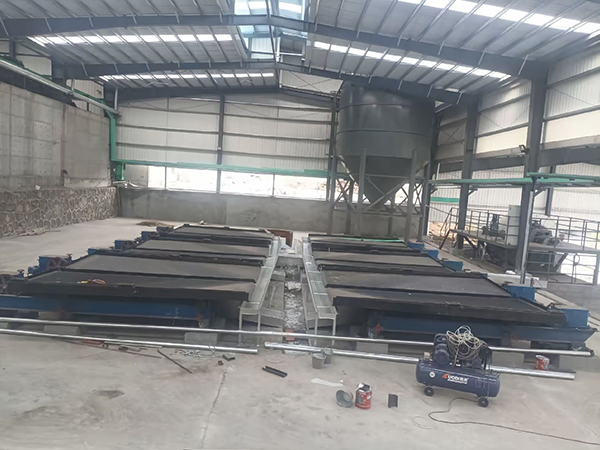
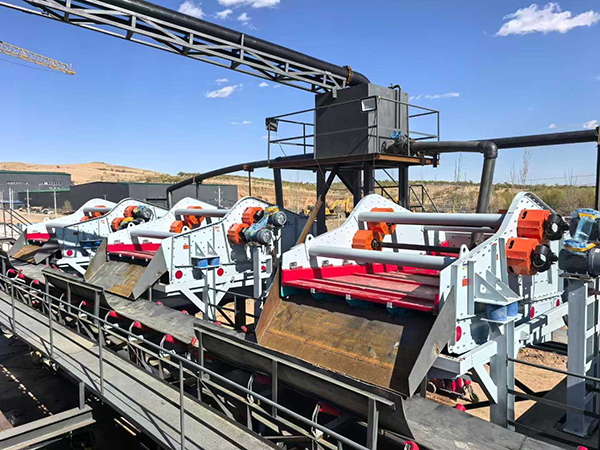
The slurry is pumped into the feed trough by a sand pump, ensuring even distribution. As the material moves along the operating direction of the blanket separator, the sorting process begins. The vibrating blanket machine continuously performs a reciprocating vibration motion. Lighter materials follow the water flow downstream, while heavier materials adhere to the blanket.
At the bottom, backwashing water flushes the heavy minerals trapped in the blanket into the concentrate collection hopper. The lighter tailings exit from the discharge end of the blanket separator and are further collected and reprocessed through the tailings drainage channel using flushing water, maximizing recovery.
Advantages
![]() | ![]() | ![]() |
High Ore-Rich Ratio: It achieves a greater concentration of valuable minerals compared to traditional methods.
High Separation Efficiency: The machine effectively separates different minerals, optimizing the recovery process.
Enhanced Supervision: It allows for better monitoring during gravity mineral processing.
Ease of Adjustment: The machine is user-friendly and allows for convenient adjustments during operation.
Space Efficiency: It occupies a small footprint while providing a large working area, enhancing overall processing capacity.
Cost-Effective: By improving recovery rates and minimizing resource use, it contributes to reduced operational costs and increased profits.
Effective for Micro-Fine Particles: Capable of separating particles from 100 mesh to 800 mesh, it recovers about 80% of valuable minerals in one process, addressing the challenge of separating fine particles effectively.
Technical Parameters
| Vibrating Blanket Machine | ||||||
| Model | Capacity(t/d) | Power (kw) | Feeding Density (%) | Feeding Size (mm) | Weight (kg) | Dimensions (mm) |
| 1200×6000 | 50-72 | 2.2 | ≤35 | 5-100 | 1300 | 7600×1500×1100 |
| 1200×8000 | 50-72 | 2.2 | ≤35 | 5-100 | 2100 | 9600×1500×1100 |
| 1200×10000 | 50-72 | 3 | ≤35 | 5-100 | 2800 | 11600×1500×1100 |
| 1400×6000 | 70-90 | 3 | ≤35 | 5-100 | 2200 | 7600×1700×1100 |
| 1400×8000 | 70-90 | 3 | ≤35 | 5-100 | 2900 | 9600×700×1100 |
| 1400×10000 | 70-90 | 4 | ≤35 | 5-100 | 3100 | 11600×1700×1100 |
| The technical parameters provided are for reference only. Final product performance shall be subject to the official technical specifications. | ||||||
Successful Cases
Rock Gold Mine - South Sudan | Alluvial Gold Mines - Zimbabwe | Chromite - South Africa |
Alluvial Chrome Ore - Zimbabwe | Alluvial Tin Mines - Bolivia | Rock Tin Mines - Indonesia |
Copper Oxide - Russia | Tantalum Niobium Ore - Nigeria | Lithium Mines - Brazil |
Kaolin Mine - Uganda | Lead Zinc Mine - Morocco | Manganese Ore - Kenya | Hematite - South Africa |
FAQ
Q: What materials suit vibrating blanket machines?
A: Ideal for tailings/slurries (15-25% moisture). Achieves 85-92% compaction density.
Q: How to select frequency & amplitude?
A: Fine materials: high-frequency/low-amplitude (40-60Hz/1-3mm). Coarse materials: opposite settings.
Q: Vibrating blanket vs roller compactor?
A: 50% better wet material compaction, 30% less energy. Ideal for slopes/irregular areas.