Views: 0 Author: Site Editor Publish Time: 2026-06-11 Origin: Site
Transitioning from geological exploration to active extraction presents significant operational challenges. Profitability in alluvial tin extraction hinges heavily on the metallurgical efficiency of the plant. Raw throughput alone cannot guarantee a successful commercial operation. Cassiterite, the primary tin ore extracted from alluvial deposits, possesses a notably high specific gravity. This density characteristic makes gravity separation the established industry standard for nearly all mining sites. However, natural ore bodies vary wildly in clay content and particle size. Off-the-shelf machinery often fails to accommodate these physical variations, resulting in unacceptable mineral loss directly to tailings. Securing the right tin mining equipment requires aligning your site-specific mineralogy with verifiable machinery capabilities. You must prioritize proven recovery rates, modular scalability, and localized technical support. Manufacturers need to demonstrate process competence rather than simply pushing standalone iron. By carefully defining your ore profile first, you create a robust foundation for long-term project viability.
Deposit characteristics dictate the flowsheet: High-clay alluvial deposits require specialized heavy-duty scrubbers before gravity separation can occur.
Gravity separation is sequential: Efficient tin mining processing relies on a staged approach—roughing, sweeping, and cleaning—to maximize cassiterite recovery.
Jig machines remain the core: The tin jig machine provides the most cost-effective primary concentration for alluvial ores with a distinct specific gravity differential.
Procurement requires metallurgical proof: Shortlist manufacturers who offer custom flowsheets based on empirical sample testing, not generic throughput claims.
You cannot purchase effective processing machinery without first understanding the raw material. Framing the business problem and establishing a technical baseline must happen before any equipment selection begins. The ore body dictates every phase of tin mining processing.
Alluvial deposits frequently contain heavy, sticky clay. You must assess whether the deposit requires aggressive mechanical scrubbing to liberate the cassiterite. Heavy clay binds mineral particles together. If it enters the gravity circuit unwashed, the clay carries valuable tin directly into the tailings pond. The clay percentage fundamentally dictates the required washing equipment type. High-clay ores demand extended retention times and high-shear mechanical agitation to break down tough agglomerates. Low-clay ores allow for simpler, gravity-fed washing solutions.
Determining the size range of the tin ore remains a critical early step. Cassiterite can range from coarse nuggets down to ultrafine powder. You need this sizing data to specify the correct screen apertures across the plant. If screen holes are too large, oversized barren rock overwhelms the downstream concentrators. If they are too small, valuable coarse tin gets rejected. Sizing data also dictates the selection of down-line equipment, as different gravity concentrators only operate efficiently within specific particle size brackets.
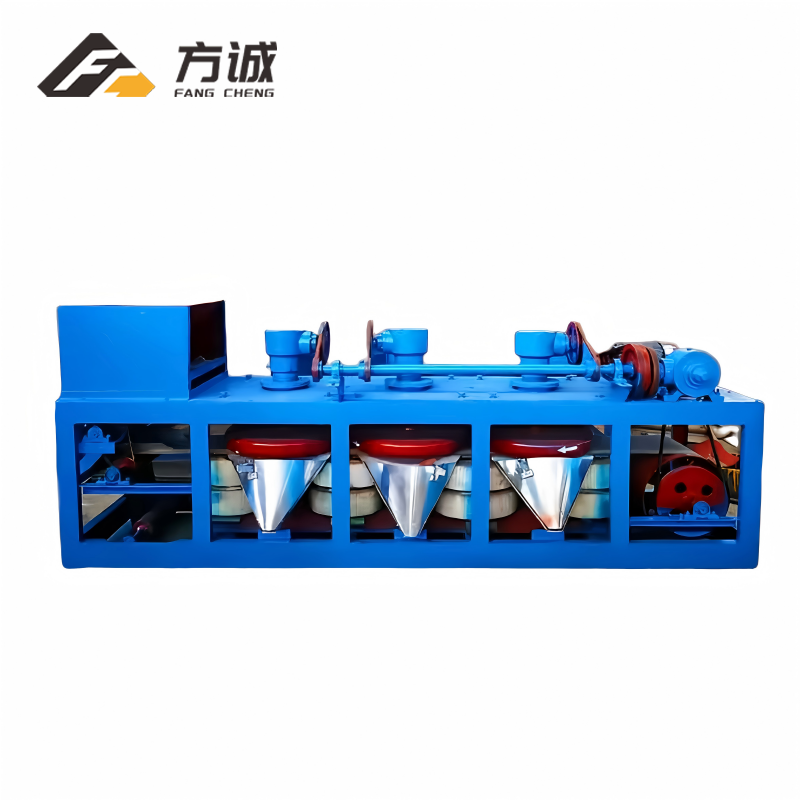
Cassiterite rarely sits alone in an alluvial deposit. You must identify if the ore body contains other heavy minerals. Ilmenite, magnetite, zircon, and coltan frequently share the same specific gravity range as tin. Gravity separation alone cannot split these minerals apart. Their presence necessitates secondary magnetic or electrostatic separation stages. Without these secondary circuits, you cannot achieve a commercial-grade concentrate.
Associated Mineral | Specific Gravity | Magnetic Property | Separation Method Required |
|---|---|---|---|
Cassiterite (Tin) | 6.8 - 7.1 | Non-Magnetic | Gravity / Base Target |
Magnetite | 5.1 - 5.2 | Highly Magnetic | Low Intensity Magnetic Separation |
Ilmenite | 4.5 - 4.7 | Weakly Magnetic | High Intensity Magnetic Separation |
Zircon | 4.6 - 4.7 | Non-Magnetic | Electrostatic Separation |
A well-designed processing facility breaks raw ore down through sequential stages. We can categorize the technical solutions by mapping specific features directly to operational outcomes.
Preparation breaks apart the raw dirt and sizes the material. A well-designed tin ore washing plant protects the entire downstream circuit.
Trommel Screens: Trommels serve best for low-to-medium clay deposits. They rotate slowly, tumbling the ore while water sprays wash the material through the screen matrix. Focus closely on screening efficiency. You should evaluate the durability of the screen panels. Polyurethane mesh offers superior wear life, while high-carbon steel mesh provides a cheaper, short-term alternative.
Rotary Scrubbers: High-clay deposits absolutely require rotary scrubbers. They look similar to trommels but feature a solid drum section equipped with internal lifter bars. These lifters pick up the ore and drop it, using the rocks themselves to smash the clay apart. When evaluating scrubbers, focus on retention time and motor torque capabilities. Underpowered scrubbers stall out when fully loaded.
The roughing stage handles massive volumes of washed material. It aims to discard the majority of the barren gangue quickly.
Tin Jig Machine: The tin jig machine remains the undisputed workhorse for alluvial cassiterite. It utilizes a pulsating water bed to separate heavy minerals from lighter rocks. Heavy tin sinks, while lighter silica washes over the top. You should evaluate jigs based on stroke frequency control, water consumption per ton, and overall bed stratification efficiency. Modern hydraulic jigs offer much tighter pulsation control than older mechanical models.
Spiral Chutes: Operators use spiral chutes for finer particle recovery where jigging becomes inefficient. As a core piece of alluvial tin mining equipment, spirals rely entirely on gravity and centrifugal force. Slurry flows down the helical path, separating heavy and light particles into distinct bands. Evaluate spirals on their footprint density and overall durability. The complete lack of moving parts keeps operational expenditure remarkably low.
The finishing stage takes the rough concentrate and refines it into a sellable product.
Shaking Tables: You need shaking tables for final upgrade duties. They operate as the ultimate tin ore separator to produce high-grade concentrate. An asymmetrical motion drives heavy particles forward while wash water pushes lighter particles laterally. Evaluate tables based on deck stability, stroke precision, and the documented recovery rates of ultrafine tin. A poorly balanced table causes turbulent water flow, washing valuable ultrafine tin away.
Vendors routinely make aggressive performance claims. Buyers need a concrete framework to evaluate these statements against engineering realities.
Operators must constantly balance the overall percentage of tin recovered against the final concentrate grade. Pushing a plant to recover 99% of the tin usually requires accepting significant impurities, which lowers the final commercial grade. Conversely, targeting a 75% pure tin grade might cause the plant to reject too much borderline material, dropping overall recovery to 60%. Acceptable baseline expectations for well-managed alluvial deposits typically target 85% to 90% recovery at a 60% to 65% concentrate grade. You must establish these benchmarks early to avoid operational disappointment.
Nameplate capacity rarely matches real-world daily output. A vendor might rate a trommel at 100 Tons Per Hour (TPH). However, nameplate ratings assume perfect, continuous feeding and ideal ore conditions. In reality, excavator delays, sticky clay bottlenecks, and pump maintenance degrade this capacity. Real-world throughput often sits 15% to 25% lower than the theoretical maximum. To calculate required capacity buffering, you should multiply your target daily tonnage by 1.25. Specifying slightly oversized equipment prevents the processing plant from becoming a site bottleneck.
Assessing the OPEX footprint ensures long-term operational stability. Alluvial separation consumes massive volumes of water. In arid mining locations, or areas strictly enforcing discharge regulations, you must integrate comprehensive water recycling systems. Thickener tanks and filter presses capture dirty water, settle the mud, and pump clean water back to the scrubber. Power consumption presents another critical hurdle. Remote sites rely entirely on diesel generators. You must carefully calculate the combined starting load demands of all pumps and motors. A poorly phased startup sequence can easily trip out site generators.
Implementation realities, capital expenditure tradeoffs, and rollout risks dictate how you physically deploy the plant.
Mobile configurations mount equipment onto wheeled trailers or heavy steel skids. They suit specific operational profiles perfectly.
Pros:
Rapid deployment across challenging terrain.
Ideal for highly fragmented or shifting alluvial deposits.
Lower initial civil infrastructure costs.
Operators can move the plant to follow the active mining face, reducing trucking distances.
Cons:
Strictly limited to lower overall throughput capacities due to weight constraints.
More susceptible to structural wear and tear from constant relocation.
Vibration dampening proves difficult, which can negatively impact sensitive shaking tables.
Stationary plants bolt directly to poured concrete foundations. They represent a permanent processing commitment.
Pros:
Extremely high throughput capabilities.
Greater metallurgical precision due to elimination of environmental vibration.
Massive economies of scale for long-life ore bodies.
Better integration of complex, multi-stage recovery circuits and automated control rooms.
Cons:
High initial capital expenditure.
Extensive civil engineering and permitting requirements.
Longer time-to-production metrics.
Ore must be trucked increasingly longer distances as the mining pit expands outward.
Vendor evaluation requires strict risk mitigation and clear commercial next steps. Selecting a partner demands more than just comparing invoice totals.
Demand Metallurgical Testing: Reject any vendor who quotes complex flowsheets without first analyzing a bulk ore sample. Off-the-shelf designs frequently fail. Competent manufacturers require a representative sample. They run this sample through lab-scale scrubbers, jigs, and tables to empirically prove the separation physics before drafting a single blueprint.
Scrutinize Supply Chain and Wear Parts: Assess the local availability of critical consumable parts. Screens, polyurethane panels, jig diaphragms, and slurry pump liners wear out predictably. A cheap initial plant becomes a massive operational liability if replacement wear parts require a six-month shipping lead time. Demand an upfront list of recommended spare parts and verify their warehousing locations.
Verify Compliance and Safety: Ensure the equipment meets regional electrical standards. Control panels must feature proper enclosures to handle dusty, wet mining environments. Additionally, review environmental compliance capabilities for tailings management and water discharge. Equipment that causes continuous environmental breaches will force regulators to shut down the site.
Take The Next Step: Request a Preliminary Economic Assessment (PEA) aligned precisely with a custom flowsheet design. This assessment should detail the power draw, water requirements, and expected mass balance of the final concentrate. Use this PEA to compare vendors objectively.
Profitability in alluvial tin extraction is never won by simply purchasing the cheapest iron on the market. Success requires securing a chemically and physically matched flowsheet. You must rigorously evaluate the raw ore body, focusing heavily on clay content and particle size, to determine the exact sequence of washing, roughing, and cleaning. Both mobile and stationary setups offer distinct advantages, but neither works efficiently if the internal separation logic is flawed. Equipment procurement must remain tied to empirical metallurgical evidence rather than theoretical throughput promises. We highly recommend initiating the procurement phase by securing an independent metallurgical analysis of your ore body. You can then use this baseline data to drive all vendor requests for proposals, ensuring your final plant delivers the required recovery grades from day one.
A: A standard washing plant typically requires 3 to 5 cubic meters of water per ton of raw ore processed. This varies based on clay content and scrubber design. Adding a dedicated water recycling and thickener circuit can recover up to 85% of this water, drastically reducing the total external water intake required for daily operations.
A: No, jigging has distinct particle size limitations. Jigs rely on water pulsation, and ultrafine particles lack the necessary mass to settle quickly against the upward water flow. Ultrafine cassiterite often washes away into the tailings. Shaking tables or specialized centrifugal concentrators are absolutely required to capture the ultrafine fraction efficiently.
A: Deployment timelines generally range from 3 to 6 months depending on scale. This timeframe includes initial ore sample testing, custom flowsheet design, equipment manufacturing, international shipping, and final site commissioning. Stationary plants with extensive concrete foundations lean toward the 6-month mark, while modular skid-mounted systems deploy much faster.
A: It depends entirely on the presence of magnetic impurities, such as iron oxides or ilmenite, within your raw ore. Since cassiterite is non-magnetic, if magnetic heavy minerals exist in your gravity concentrate, you must add dry or wet magnetic separators to the finishing stage. This ensures your final tin concentrate avoids severe smelter penalty thresholds.