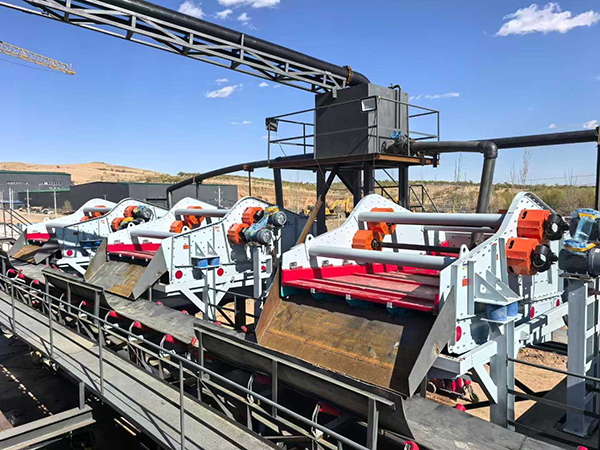
The 50-200t/h Wheel Sand Washer delivers superior sand purification for construction, mining, and aggregate industries. Its rotating wheel design efficiently removes impurities like clay, silt, and organic matter, producing high-quality sand for concrete, asphalt, and glass manufacturing.
Raw sand enters the washing tank via a feed hopper. A rotating impeller with paddles agitates the material, creating a turbulent water-sand mixture. This agitation loosens surface contaminants, which dissolve or suspend in the water .
As the wheel rotates, cleaned sand is lifted by the paddles to the discharge chute. Fine impurities and excess water overflow through a weir into a settling tank, where solids are removed for recycling or disposal.
Integrated cyclones and filters reclaim 80% of washing water, reducing consumption to 3-5 m³/t of sand. This closed-loop system minimizes environmental impact and operational costs.
Removes 95% of clay and silt from sand, meeting ASTM C33 and EN 12620 standards for construction aggregates. The washed sand has a moisture content of ≤8%, reducing drying time.
The variable-speed motor (15-30 kW) adjusts to sand quality, saving 25% energy compared to fixed-speed models. The water recycling system cuts freshwater usage by thousands of liters daily.
The washing tank and impeller are made from abrasion-resistant high manganese steel (16Mn), ensuring 10,000+ hours of service. Sealed bearings prevent water and sand ingress, reducing maintenance .
![]() | ![]() | ![]() |
The Sand Washing Machine features an optimized design delivering high capacity (50-200t/h), 30% energy saving, and exceptional cleanliness (≤1% silt content). With wear-resistant alloy components and only one replaceable part (screen), it achieves 5-8 years lifespan and 60% lower maintenance. Its patented impeller minimizes fine sand loss, maintaining stable fineness modulus (2.3-3.0) per ASTM C33 standards.
| Sand Washing Machine | |||||||
| Model | Specification(mm) | Feedsing Size(mm) | Capacity(t/h) | Motor Model | Motor Power(Kw) | Weight(t) | Dimension(mm) |
| YC2610 | ø2600*1000 | ≤10 | 20-50 | Y160L-8 | 7.5 | 2.68 | 3321*2312*2683 |
| YC2816 | ø2800*1600 | ≤10 | 30-70 | Y180L-8 | 15 | 5.3 | 3810*2820*2883 |
| YC3016 | ø3000*1600 | ≤10 | 50-100 | Y200L-8 | 15 | 6.5 | 3830*2972*3200 |
| YC3620 | ø3600*2000 | ≤10 | 80-150 | Y255S-8 | 18.5 | 9.8 | 4456*3479*3688 |
| The technical parameters provided are for reference only. Final product performance shall be subject to the official technical specifications. | |||||||
Rock Gold Mine - South Sudan | Placer Gold Mines - Zimbabwe | Chromite - South Africa |
Alluvial Chrome Ore - Zimbabwe | Alluvial Tin Mines - Bolivia | Rock Tin Mines - Indonesia |
Copper Oxide - Russia | Tantalum Niobium Ore - Nigeria | Lithium Mines - Brazil |
Kaolin Mine - Uganda | Lead Zinc Mine - Morocco | Manganese Ore - Kenya | Hematite - South America |
Modify water flow rate or impeller speed via the control panel. Higher speeds and water volumes enhance cleaning for heavily contaminated sand.
It handles sand particles up to 5 mm. Larger gravel should be screened out beforehand to prevent damage to the impeller.
Yes, optional stainless steel components resist corrosion in saltwater environments. A secondary rinse cycle further reduces chloride levels to meet construction standards.